

(Warning- contains pictures of dogs wearing shock collars)
When your puppy turns into an adolescent dog, you may be tempted to use anything to help you. There’s a whole range of training methods, information guides, and equipment to use. Videos online show seductive footage of the dog quickly walking nicely, keeping by the owner, and look so well behaved. Isn’t’ that what you want? And sometimes when you’re at your wits end, your dog’s pulling you around and your just really frustrated, you might certainly be wanting to use a quick fix, but quick fixes don’t always work.
What they do is maybe suppress what your dog is currently doing, but you’re not actually coaching them into what you want them to do instead.
The UK has just announced that a ban on e-collars will happen from 1st February 2024 and for me, this is brilliant news. But what is an e-collar?
An e-collar is known as an electric collar, shock collar, stim collar or as I’ve recently seen an ‘educational’ collar. It’s a tight that sits very close to the throat and it has a box on it and on the inside box closest to your dog’s neck are two metal prongs about an inch apart, and these sits either side of your dog’s windpipe. You have a remote control. When you press the button it provides a shock to your dog’s neck. You can press the shock for up to 11 seconds with up to a two mile range, so your dog can be completely out of sight and you can deliver an electric shock to them.
It’s used as a correction or punishment (means the same thing). The shock is applied to your dog so in theory it interrupts them to whatever they are doing and supposedly change their behaviour such as to stop running, or barking at a dog. It can cause peaks in heart rate, and burns to the skin.
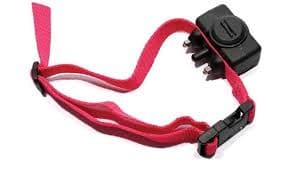
There are some that don’t have a remote. These are linked to invisible fences, that is a wire around your perimeter of your property and every time your dog goes near it, it gets a shock.
There’s also other gadgets like prong collars, spray collars and choke collars/leads. Prong collars are the choke collars with the spikes on the inside. Slip leads are designed as choke leads, but it’s only the electric collars with a remote control that’s under this new ban.
Since the announcement, there has been a right to-do on social media from trainers and owners that use the e-collars, and to be honest, quite a slating towards anyone who thinks they are barbaric.
There’s quite a few arguments being put forward to keep them but I really don’t see the validity in these as I rely on kind ethical methods, and that’s about setting your dog up for success, motivating them to do the correct choices and managing the environment so they can’t make mistakes. For me, training is coaching and there is the skill in my trade. But there’s also other methods quite often used by aversive trainers.
Balanced trainers are those who may use reward methods, but they will also use corrections, including e-collars and prongs. One of the arguments is “how can I be against something if I don’t use it? I obviously don’t know about it. I don’t use it correctly. It’s okay if you use it correctly.”
Well, to use it correctly you are giving your dog an electric shock. Simple as that.
Your dog doesn’t know what it is. It’s like you are suddenly walking along and stepping on an electric fence and it gives you a fright. You’ve got no idea why as you didn’t see it, and it can hurt. Who are we to judge and say what hurts the dog and what doesn’t? Pain thresholds are individual.
And if it’s used correctly, then why does the dog need to keep wearing it? Because surely if, if, say for example, it started to chase a deer, it got an electric shock, and in theory it’s supposed to stop chasing deer again, then surely you don’t need the to use a shock collar again because your dog has allegedly learnt not to chase.
But that’s not the case. They don’t work like that. I do know how they work. I choose to not use them at all. Point blank refuse and I do not support the use of them on any client dogs either.
But people say if it’s used correctly, it’s just a tickle sensation. Well, a tickle sensation is not going to stop a dog in its tracks. And a recent survey showed that even though owners were instructed by ‘someone who knew how to use these correctly’, 70 to 80% of owners instantly cranked up the intensity as soon as they got home, regardless of what they were told on how to use it.
They’re made to hurt. They’re made to startle or hurt the dog.

Why are they so bad and what can happen when you use it?
If your dog is prone to barking at other dogs but you’re using the shock to startle them to stop them barking, your dog at the time is looking at some children next to the dog. It will start to learn that every time it sees some children, it gets a shock. Do you think your dog will want to see children? Absolutely not, because as soon as children come into view, your dog knows there’s going to be some pain. So this actually creates more reactivity because your dog is almost screaming at the children “Go away. Go away, because I don’t want to have this shock.” But quite often owners just see a dog barking and so shock them even more. You were not using the shock for the reason of the children being there, but that is the association your dog is learning.
Dogs have different pain thresholds. Quite often if they are so intent on something, they will work through the pain. A lot of gun dogs have a much higher pain threshold than other breeds because that’s how they’ve been bred. And this is quite common with certainly the invisible fences (the electric fences).
Imagine your dog sees a squirrel. They are so focused on the squirrel that they will go through the pain to run over the fence line, receive the shock, but will carry on because they are continuing to chase that squirrel. And then once squirrel’s gone out of range and the dog’s hormones start to balance and focus back on their environment, they come back towards your property, they can’t get home, because every time they get near your property boundary, they get an electric shock. So your dog is literally stuck outside your property. Your dog is learning that actually getting near your house is painful.
A big argument, again, by aversive and balanced trainers is to say that waving food around doesn’t work. I agree, a few crunchy biscuits are no match to the squirrel chasing euphoria, but you don’t need to electrocute your dog to get their attention. This is why other trainers shout that ‘force-free’ training is rubbish and we are all failed trainers.
Firstly I prefer to call myself a fear free trainer.
It’s not only about food. It’s about finding your dog’s motivation. It’s about coaching and teaching them. It’s not about scaring them into submission. I think about the ethics. I think of what I do, how I do it. I think about the welfare of the dog. What is the dog feeling and what is the dog learning at the time?
Yes, reward training is hard work. It involves management, it involves consistency, but to change your habit, there is no quick fix. Buying a gym membership for myself is not going to give me a skinny body I wish for. No, you have to put the time and effort and consistency to see any changes.
But reward training works. The fallout of using rewards is that dog has a bit more food than they should, but that’s easily solved by just reducing their dinner portions down a fraction. And it’s not always about food, certainly when out and about. Yes, a few biscuits is not going to tempt your dog, but we are teaching them to make good choices and rewarding them in the way that they like to be rewarded. And this could be a game with us or a game of tug. It doesn’t always have to involve food.
When you get owners saying, well, my dog should be off lead all the time, they have a right to roam free. Again, I do not agree with this. Many areas where we walk is private land or farms. It’s not a free for all. These are people’s property, their livelihood, their livestock. No dog has a right to roam free on private lands, and actually, if your dog is prone to chasing deer and killing them, then no, they should be on a lead/harness and you hold the other end. Your dog does not have a right to roam free. If you want them to have a run around, there are plenty of secure enclosed fields where your dog can run around safely to their heart’s content where you can play games or they have a buddy with them.
But in certain areas and at certain times, honestly, keeping your dog on lead is the best thing as they can have just as an enriching walk than off lead. In fact, I know dogs that are more tired from having a calmer sniffy walk. When they charge around like loons, they have an adrenaline spike and basically lose their heads, their hormones keep them alert and ramped up for a long time after you get home. To really satisfy a dog, use their nose and brain. But certainly there is no right to roam free around farms and livestock.
That brings me to another big argument going on. Wales banned the electric collars, the shock collars about 12years ago, and recently people are saying that there has been a recent rise in attacks on livestock, on sheep and cattle, blaming it on not allowing electric collars.
According to some news, there have been more attacks in the last few years, but that is not correlated with the time of the ban there.
If we think about recent years, dog ownership has gone up from about 9 to 12 million, and that was just through the first year of the pandemic. From just a couple of years ago, 3 million more households now have dogs. That’s a huge increase. And also a lot of people got dogs during lockdown weren’t going to training classes nor did they participate in online training. So there’s a lot of poorly trained dogs who are now a couple of years old going through their hormonal adolescence.
During the pandemic we couldn’t go overseas. Many owners now with dogs would much rather holiday within the UK. And Wales is a very popular, lots of countryside, lots of greenery, some fantastic national parks there. There’s a lot more places to stay with the rise of Airbnb, so there’s a lot more people staying within the UK for holidays, whereas they would’ve gone overseas before. So there’s more dogs, there’s more people visiting the area, and there’s been less dog training.
And I think there’s also been a bit of a shift in attitude and some lack of responsibility, a lack of really understanding your dog and what it means to be a dog owner. It’s not just letting your dog run around. There’s an awful lot more that we have learnt about dogs to give them an enriching life, and that is having some boundaries, having some manners, meeting their mental needs as much as their physical needs. So there may be more attacks on livestock in Wales, but it’s not to do with e-collars. It’s actually more to do with more visitors and more dogs and probably less responsibility and less training.
If dogs really liked the shock, because again, one of the arguments is “oh, it doesn’t hurt them.” But if they really liked it, then surely they’ll continue doing the behaviours to keep getting this little tickle, this vibration, this ‘non-painful’ shock onto their throat. It’s not a little buzz. If they liked it, they would ignore us and continue doing the things that they were doing to keep getting that buzz instead. Instead they avoid it. They stop and freeze. They often do not know what they need to do to stop the pain, and stop trying anything, they shut down. Their body language looks very meek. They become too scared to do anything in case they get another shock. This is not nice or fun for our dogs. The only benefit is the human’s ego, looking macho. And that is not a reason to use them.
You haven’t actually taught them what you want to do. We need to teach, encourage and motivate your dogs.
Many balanced trainers state that more dogs will be euthanised if they can’t use shock collars, it’s the only thing that keeps a dog alive. The reality is very different. There is a huge number of super skilled reward trainers that help these difficult dogs. In fact the Put To Sleep rate is higher amongst balanced/aversive trainers as the repercussions of using aversives is greater than reward training – you may supress one behaviour but it emerges as a stronger behaviour – or a new one. Your dog can get so frustrated at not being able to supress what is probably a very natural behaviour for them will often result in bites.
Imagine you are on a diet, this is why your cravings for the ‘naughty’ foods becomes so overwhelming that you tend to binge on them. Now if we use this analogy on a dog, then the fallout can be serious injury to them, you or another dog.
Unpicking and changing habits and emotions is tough going, and a long road. It’s not easy but reward training has been shown to be more effective longer term. If your trainer cannot help your dog without using an e-collar (or prong), and threaten that your dog will be PTS without one, then they are not a good trainer, they don’t have the skills and understanding to actually do the job they profess to do. There is a reason why Clinical Behaviourists are all reward trainers. They are skilled and it’s the method that works. Its not 100%, but certainly better than shocking your dog.
Another argument is about deaf dogs. The common quote is that they need the stimulus so they know when we need to communicate with them. But I know many deaf dogs that have been trained without the use of any electric collar, they’re taught to check in a lot. They’re taught to listen to our body language as much as we are listening to theirs.
And a lot of the work, yes, it’s on harnesses and long lines, but I know many deaf dogs that can be off lead because they have been taught to check in regularly, and that was not through the use of an e-collar.
And a final gripe against the force free/fear free trainers is the critique that science flawed. Well, all trainers have access to the same science, the same studies. But quite often what happens is that we choose, or we have a bias towards the science where we like the results and we can pick bits we like.
There are some flawed studies out there. Some projects are sponsored to create one result, or the sample size is so small that you cannot make any reasonable conclusions from it about behaviour. I know many balanced/aversive trainers ignore science stating it’s not relevant (probably as it doesn’t support aversive methods). I would say it’s very relevant. All our learning is learning. It’s like I had someone say to me that they didn’t believe in any science since the 1960s because it’s just the same stuff written by new people. Well that argument’s very flawed. Just think of medical science. If we were still having the same understanding of things like cancer that we did in the sixties to now, there wouldn’t be anything like chemo, radiotherapy and all these other therapies that actually are there to help us.
So science does move on and that’s the whole point of science. It pushes, it tests. Some things work, some things don’t. That’s the nature of it. But actually the science is there in reputable studies that show that reward training is longer lasting, it’s more beneficial, and primarily it considers the welfare of the dog, and that’s where it’s all got to be centred around.
So I’ll welcome the ban on e-collars. I do know what they do. I don’t want to use one on my dog. I’m not going to use any other prongs, spikes, or shocks to my dog, because you know what the real skill is?
Coaching.
Coaching and encouraging. You don’t put a sticking plaster over a broken leg. You need to deal with a root of the problem.
And so an e collar is a bit like a sticking plaster. It doesn’t actually address the root cause.
So I’m happy that the ban will come in. It’s a shame we have to wait, and I do hope that the other aversive tools fall into the same category soon as well – the electric fences, the prong collars, the choke leads. These are the gadgets that really caused a lot of damage to dogs. Yeas, normal collars can hurt if a dog pulls a lot but we’re not deliberately correcting the dog.
But the skill is to teach a dog. You know, to walk a bit better, walk at our pace because we are slow compared to dogs. We need to teach our dog the emotions about seeing other people and dogs so they’re not barking and lunging and we don’t need to shock them to stop.
We need to work on the emotions. Why is your dog barking and lunging? Let’s help them feel a bit better about seeing these triggers. That’s the skill and that’s the sort of training that I support is to help your dog to set them off for success, not correcting them as a quick fix or to make my ego feel better.
Don’t be tempted to reach for a quick fix gadget. Ask yourself, does this feel right doing this? Would I inflict this on a child or a cat or any other animal? How does it fit with my feelings, my ethics, my values? Just because you’ve seen somebody on social media or on YouTube, or maybe you’ve paid to see a trainer and they are telling you that you have to use these.
You don’t have to do any of that. Go with your gut. Does it feel right? Think about how your dog will feel. Do you feel comfortable using this on your dog? Just because somebody tells you that you must use this in order to work with them, you don’t. It’s the same as if somebody asked you to jump off a cliff. You have a choice. Does it feel right to do that? Or do you turn around and walk away? There are other effective ways to train your dog without giving them a shock or an injury.
Contact me to find out how you can work with me.
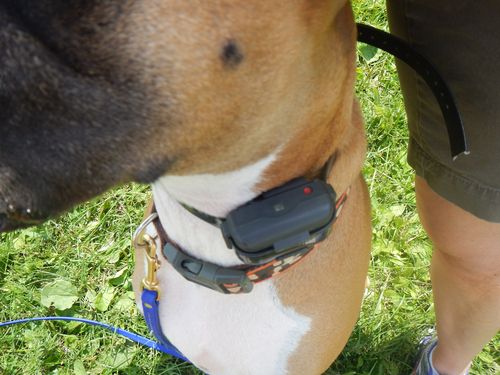
Note – dog trackers are a box on the collar and can look similar but have NO aversive effect on your dog – you are just able to find them!